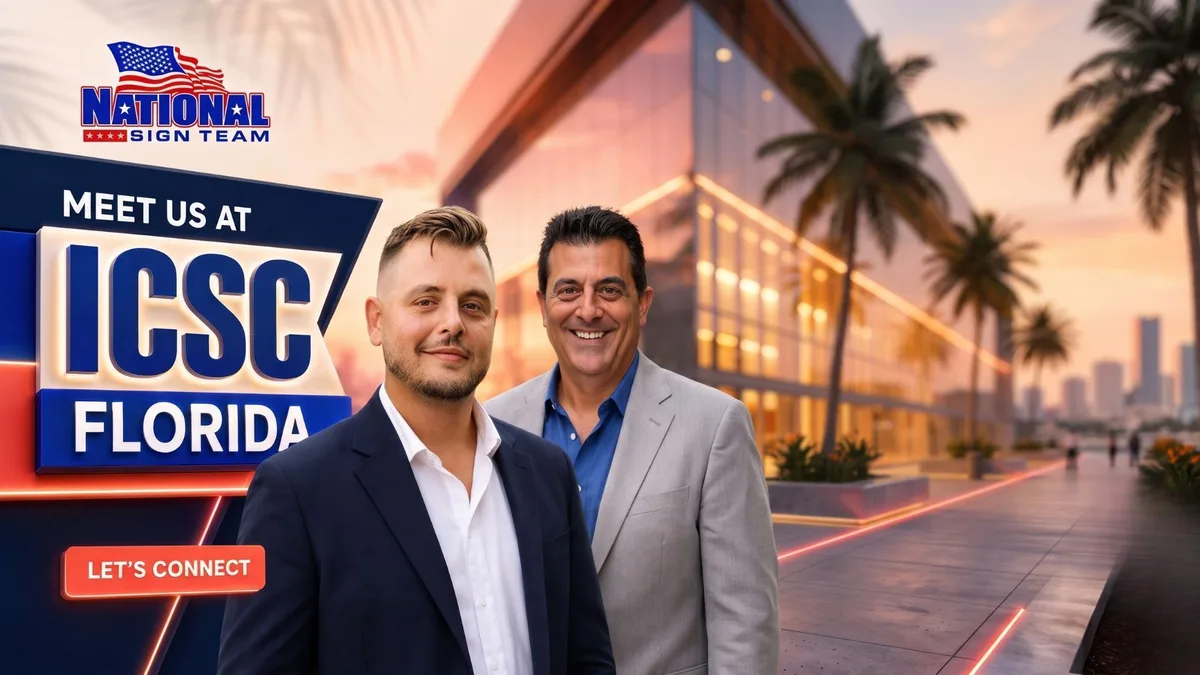
ICSC is coming up August 31 through September 1, 2026, and there will be plenty to see. New products. New technology. Big booths. Industry trends. People telling you what is going to change everything.
Some of it will be worth your time. Some of it probably will not.
After more than 40 years in the sign industry, we have learned that the best conversations at a show like ICSC usually are not about whatever happens to be getting the most attention that year.
They are about solving actual problems.
▶ Watch: Meet Signage LeadersHow do you keep a brand consistent across 75 locations?
What happens when a city will not approve the sign package you use everywhere else?
Is that new digital technology actually useful, or is it something you will regret owning three years from now?
How can you open locations faster without creating problems later?
Those are the conversations we want to have at ICSC.
If you have 30 minutes while you are there, sit down with Dan and Mike from National Sign Team. Bring a problem. Bring an idea. Bring something you have been trying to figure out. That is probably a much better use of 30 minutes than collecting another stack of brochures.
Mike Has Probably Seen the Problem Before
Mike has been in the signage industry for more than 30 years. That matters. There are plenty of situations in this business where experience saves you from making an expensive mistake.
- A permit gets rejected.
- A landlord changes a requirement.
- A location opens in a municipality with completely different sign codes than the last one.
- A brand package looks great on paper but does not work with the building.
- A rollout schedule starts slipping.
Mike has spent decades dealing with those kinds of situations. He has worked with well-known brands in retail, fashion, hospitality, and quick service restaurants, where one sign project can quickly turn into dozens or hundreds of locations.
That gives him a perspective that is difficult to get from reading specifications or looking at product catalogs. He understands what actually happens once a sign program leaves the conference room and starts moving through site surveys, permitting, manufacturing, shipping, installation, inspections, and maintenance. And sometimes the best advice is knowing when not to do something.
Then There Is Dan
Dan approaches signage from another direction. He wants to know what is next.
- What new technology is actually getting better?
- What materials are becoming more practical?
- Where can digital signage improve the customer experience?
- Can lighting be more efficient?
- Can a new fabrication technique make something possible that was difficult a few years ago?
Give Dan a strange problem and he will probably enjoy it. That curiosity is important because the industry really is changing. LED technology continues to improve. Digital displays are becoming easier to manage. New materials and manufacturing methods are creating options that did not exist a decade ago.
But again, new does not automatically mean better. The trick is figuring out where new technology belongs. That is where Dan spends a lot of his time.
Not Every New Sign Idea Is a Good Sign Idea
The sign industry has no shortage of new technology. Some of it is excellent. Some of it solves a real problem. Some of it looks impressive at a trade show and becomes a maintenance headache later.
Mike is good at separating the two. When you have spent three decades watching materials, lighting systems, fabrication methods, digital products, and installation techniques come and go, you start recognizing the difference between a trend and something that will actually improve a sign program.
That does not mean staying stuck in the past. It means asking better questions.
Does this technology improve visibility?A new lighting system or display needs to actually make your brand stand out and communicate better with your customers.
Does it reduce maintenance?Impressive tech isn't worth much if it constantly requires expensive service calls or replacement parts down the line.
Can it be deployed consistently?A solution that works on one building needs to scale cleanly across dozens or hundreds of different architectural styles.
And maybe most importantly, does it solve a problem we actually have? Those conversations can save a company a lot of money.
Mike Is Also the Guy You Want to Know When Things Get Complicated
Every sign program eventually runs into something unexpected. Sign codes vary dramatically from one municipality to another. Permitting requirements change. ADA requirements have to be considered. Buildings rarely match drawings perfectly.
Sometimes the problem is straightforward. Sometimes you need someone who knows who to call.
Mike has spent more than 30 years building relationships throughout the industry. Fabricators. Installers. Designers. Permit specialists. Vendors. People who understand specific markets and specific problems. That network is valuable.
When a client calls us with a problem in a market halfway across the country, the answer is often not, "We will start looking for someone." The answer is, "We know who we need to talk to." That comes from years of doing this work.
Technology Should Solve Something
We are interested in innovation, but National Sign Team is not interested in adding technology to a project just so we can say it has technology. There needs to be a reason.
- Maybe a digital display lets a restaurant change messaging throughout the day.
- Maybe a new lighting system reduces energy use and maintenance.
- Maybe different materials improve durability in a difficult climate.
- Maybe better controls allow a company to manage signage across a large group of locations.
Those are useful changes. Technology works best when customers barely notice the technology itself. They simply notice that the experience is better. That is the kind of innovation Dan looks for. He is constantly evaluating new products, materials, lighting systems, digital platforms, and ideas to figure out where they make sense in the real world.
Mike and Dan Do Not Always Look at Things the Same Way
That is a good thing.
Mike brings more than 30 years of experience and tends to ask, "What could go wrong?" Dan looks at a new idea and asks, "What could we do with this?" Those two questions belong in the same room.
A new idea needs someone willing to explore it. It also needs someone who has enough experience to see the problems hiding around the corner. That balance is a big part of how we approach projects at National Sign Team.
We do not want to keep doing something a certain way just because that is how the industry has always done it. We also do not want a client to spend money chasing something new when a simpler, proven solution would work better.
Sometimes the right answer is new technology. Sometimes the right answer is something we have been doing successfully for 20 years. Usually the best solution comes from understanding both.
Think About the Next Five Years, Not Just the Next Sign
One of the biggest mistakes we see is companies solving one location at a time without considering what happens when that solution needs to be repeated. One location becomes five. Five becomes twenty. Twenty becomes one hundred. Suddenly, a decision that seemed small becomes a standard.
That is why we like talking about the bigger picture.
Scalability & CodeCan local code requirements be accommodated across different municipalities without losing your core brand identity?
Maintenance & PartsHow easy will the program be to maintain? Are replacement parts easy to get, and is the technology likely to remain supported?
Internal WorkloadHow much work will your internal marketing and facilities teams have to do to actively manage it?
A good signage strategy should make future locations easier, not harder.
We Also Want to Hear What Keeps You Up at Night
Every company has one part of its sign program that creates more headaches than it should.
For one brand, it is permitting. For another, it is inconsistent fabrication. Someone else cannot get accurate site surveys. Another company is constantly dealing with lighting failures. Sometimes nobody inside the organization even owns the entire process, so marketing, facilities, construction, and vendors are all working from slightly different information.
Those are exactly the problems worth discussing.
Mike can bring decades of practical experience to the issue. Dan can look at whether a different technology, process, or approach could solve it. Between the two, we can usually get pretty far in half an hour.
Give Us 30 Minutes at ICSC
We know how trade shows go. Schedules get packed quickly. You start with an organized calendar and eventually find yourself having a conversation in a hallway while trying to make your next meeting.
We are flexible. Meet us for coffee in the morning. Grab lunch. Sit down for 30 minutes in the afternoon. Meet for a drink at the end of the day. Or catch us in the lobby if that is the only time that works.
The format does not matter much. The conversation does.
ICSC is August 31 through September 1, 2026. If you are going to be there, set aside 30 minutes with Dan and Mike. Do not worry about preparing a sales pitch for us. Just bring the challenge you are working on. We will take it from there.
Schedule Your ICSC Meeting Here